Summarize and analyze this article with:
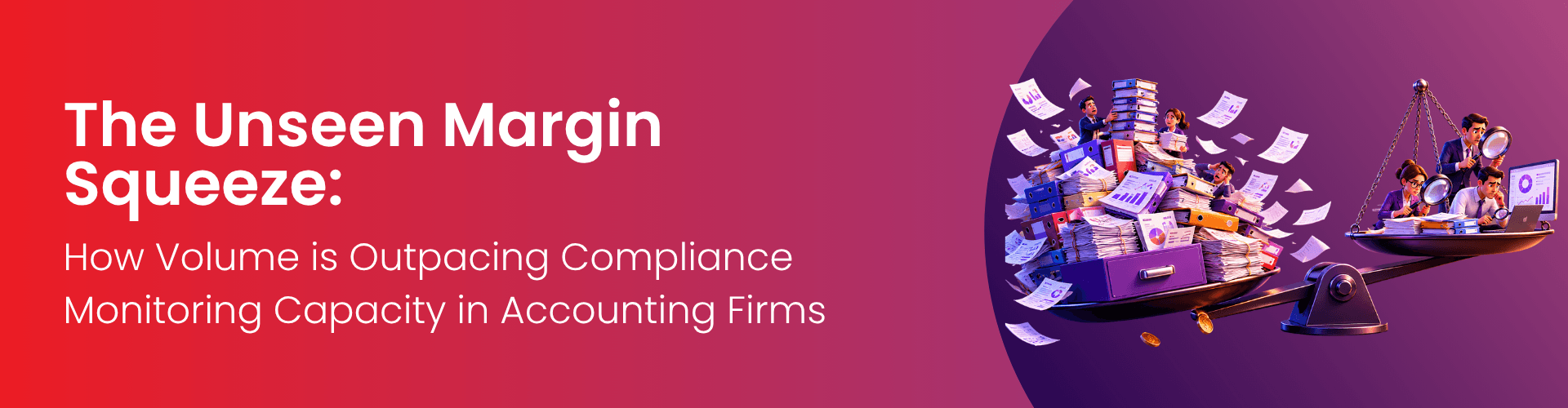
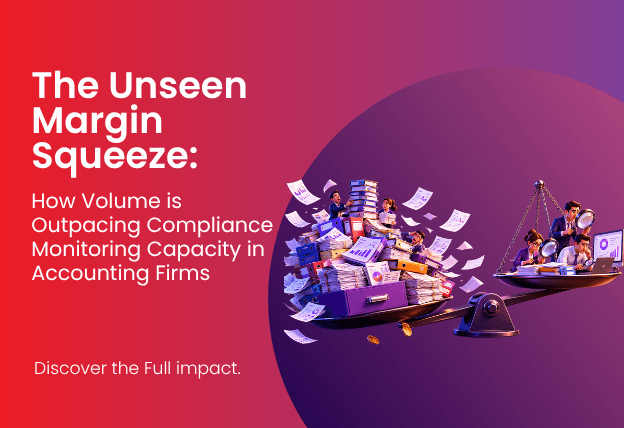
The Unseen Margin Squeeze: How Volume is Outpacing Compliance Monitoring Capacity in Accounting Firms
August 25, 2026
IMS Decimal Updates, Outsourced Accounting and Finance Services
As client rosters grow and regulatory obligations multiply, many accounting firms are facing a quiet but compounding crisis as their compliance function capacity is no longer keeping pace with operational volume. This structural tension at the heart of firm growth and a smarter approach to back-office delivery can restore the balance.
There is a particular kind of pressure that accounting firm leaders rarely discuss openly. It does not announce itself with a single missed deadline or a client complaint. Instead, it accumulates quietly across quarters, in stretched review cycles, in partners doubling as compliance gatekeepers, in teams that are technically busy but operationally overstretched.
That pressure has a name: the compliance monitoring gap.
A firm’s growth, by nearly every conventional measure, is a positive signal with more clients, more engagements, and more recurring revenue. But volume without proportional capacity is a liability dressed as success. When the work coming in consistently outpaces the infrastructure built to govern it, compliance signs begin to surface; subtly at first, then in ways that are difficult to contain. Understanding how this gap forms, and what it costs, is the first step toward addressing it before the margin erosion becomes irreversible.
What Compliance Review Actually Requires at Scale?
Compliance review is a continuous operational discipline encompassing the following:
- Deadline tracking
- Documentation validation
- Regulatory interpretation
- Internal review protocols,
- Exception management across every active client engagement
For a firm with twenty clients, this is manageable. For a firm with two hundred, it demands dedicated infrastructure and deliberate process ownership.
The challenge is that most firms do not build compliance infrastructure ahead of their growth curve. They build it reactively, often in response to a near-miss or a regulatory audit finding. By the time formal compliance review processes are formalized, the volume has already created gaps that are difficult to close without significant structural change.
A routine regulatory compliance review, when conducted properly, requires current-period documentation, cross-referenced source records, and a clear audit trail linking every transaction to its corresponding obligation. Performing this accurately across a high-volume client portfolio is resource-intensive by design. It cannot be compressed indefinitely without consequence and yet, under capacity pressure, compression is exactly what happens.
How Volume Growth Creates Invisible Risk?
Growth in accounting firms does not distribute evenly across service lines or delivery teams. A firm that adds fifteen new clients in a single quarter rarely adds fifteen corresponding review personnel. Instead, existing staff absorbs the incremental workload, often without any formal acknowledgment that their bandwidth has structurally changed.
Over time, this absorption model produces a specific set of compliance signs that, taken together, indicate systemic strain. Review turnaround times quietly lengthen. Documentation completeness drops from exhaustive to adequate. Deadline buffers that once existed as a matter of professional discipline start functioning as hard deadlines rather than internal checkpoints. The compliance review cycle, which should function as a quality gate, begins to operate more like a formality checked, but no longer rigorous.
Industry data reinforces that regulatory complexity ranks as the top challenge for accounting firms heading into 2026, followed closely by capacity constraints around getting work done on time with limited staff. These two pressures, regulatory obligation and human throughput, are not independent variables. They interact, and when they do, compliance is the function most likely to bear the cost. For a detailed view of how these dynamics play out across the accounting and financial services landscape, the structural tension is hard to ignore.

Compliance Signs That Signal the Gap Is Widening
There are observable patterns that emerge when a firm’s compliance tracking capacity is under genuine strain. None of these signals is definitive in isolation, but collectively they constitute a meaningful diagnostic picture.
Review cycle elongation
When the time between work completion and compliance sign-off consistently exceeds internal benchmarks, not because of complexity, but because review resources are occupied elsewhere.
Escalation frequency
If partners or senior staff are regularly pulled into resolution tasks that should be handled by the review tier below them, the capacity hierarchy has collapsed upward. This is expensive, disruptive, and unsustainable.
Documentation inconsistency
Compliance review depends on standardized, complete work papers. When inconsistencies in documentation format or completeness appear with increasing regularity, it often signals that preparers are operating under time pressure and reviewers lack the bandwidth to enforce standards consistently.
Client-facing delay
When compliance delivery timelines begin to slip toward client-visible deadlines rather than internal buffer dates, the margin for error has effectively disappeared. What was once a governance buffer has become a structural vulnerability.
Taken together, these compliance signs indicate not individual lapses but a systemic imbalance between the volume being served and the capacity available to govern it.
Why Traditional Resourcing Responses Fall Short
The CPA supply constraint is not a short-term anomaly; it is a structural feature of the current professional landscape.
- Firms that anchor their compliance function expansion strategy to domestic hiring alone are building on an unstable foundation.
- Recruitment lead times, onboarding periods, and the learning curve required to reach effective review proficiency mean that by the time new hires are fully productive, the compliance backlog has typically grown further.
This is precisely where outsourced accounting services offer a structurally different kind of answer. The case for outsourcing has matured well beyond cost arbitrage. Firms that have moved toward outsourced back-office models for compliance-adjacent functions like reconciliation, bookkeeping, documentation preparation, and period-close support that have consistently reported improved internal review capacity as a direct result.
There are, of course, persistent misconceptions about what outsourcing can and cannot deliver. Many of these myths about outsourcing accounting work have been examined at length, but the most relevant one here is the assumption that outsourced teams lack the contextual understanding required for compliance-sensitive work. This is not borne out by the evidence as well-structured outsourced back-office engagements, built around documented workflows and clear quality standards, consistently deliver preparatory work that supports rather than undermines internal compliance oversight.
The Strategic Role of Outsourced Back Office in Compliance Architecture
The most effective response to the compliance gap is not simply to add more reviewers. It is to redesign the delivery architecture so that internal compliance resources are applied where they generate the most value at the review and oversight layer rather than being consumed by preparatory and administrative work that could be delegated.
Accurate and timely bookkeeping is the foundation on which every compliance review rests. When that foundation is solid; when records are current, categorized correctly, and reconciled before they reach the review tier, the entire compliance function operates more efficiently.
The firms that have navigated this transition most successfully are those that treated outsourced back-office engagement not as a cost reduction measure but as a capacity architecture decision. The question they asked was not “How much can we save?” but “How do we ensure that our compliance review capacity scales in proportion to our client volume?” That reframing produces fundamentally different outcomes.
How IMS Decimal Supports Compliance-Ready Accounting Firms
IMS Decimal works with accounting and financial service firms that are navigating exactly this kind of structural tension. Through purpose-built outsourced accounting services, IMS Decimal enables firms to maintain and expand their compliance function capacity without the constraints of domestic hiring timelines or the risk of quality degradation under volume pressure.
The engagement model is built around process integration rather than task delegation. IMS Decimal’s teams operate within the firm’s existing workflows, documentation standards, and technology environments, delivering preparatory and back-office work that arrives at the review stage in a form that supports rigorous, consistent compliance oversight. The goal is not to replace internal judgment; it is to ensure that internal judgment is being applied where it matters most.
If your firm is beginning to see compliance signs that suggest the monitoring function is under strain, the structural response is worth examining sooner rather than later.
FAQs
What are the early compliance signs that a firm’s monitoring capacity is under strain?
Early signs include elongated review cycles, increasing partner escalations, inconsistent workpaper quality, and delivery timelines that begin pushing against client-facing deadlines.
How doe IMS Decimal improve compliance tracking capacity?
Outsourced back-office support provided by IMS Decimal handles preparatory work, freeing internal reviewers to focus on regulatory compliance review rather than correction and preparation.
What is the difference between a compliance review and routine bookkeeping?
Compliance review validates obligations and documentation integrity at the oversight level; bookkeeping maintains the underlying records that make a credible compliance review possible.