
Summarize and analyze this article with:
How Payroll Data Can Help Care Homes Reduce Agency Spend and Improve Workforce Planning
August 26, 2026
IMS Decimal Updates, Outsourced Accounting and Finance Services
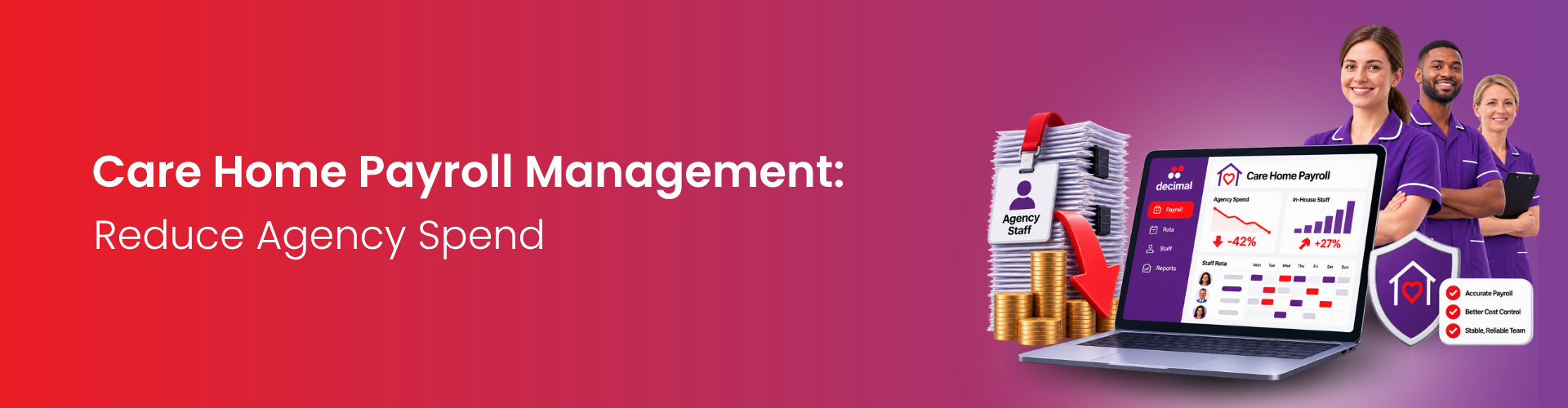
Care home payroll management is no longer simply about making sure employees are paid accurately and on time. For UK care providers facing continued pressure on staffing costs, payroll data can provide valuable insight into where agency spend, overtime and workforce inefficiencies are affecting financial performance. When payroll information is analysed alongside rota, absence, vacancy and staffing data, care home operators can identify patterns that support better workforce planning and reduce unnecessary reliance on agency staff.
For many providers, agency expenditure is now viewed as an unavoidable operational cost. A home experiences short staffing, an agency is contacted and the immediate staffing gap is filled. The process may protect service continuity, but when repeated week after week, the underlying financial problem can remain hidden.
The real issue is often not that a care home uses agency staff. It is that the organisation does not have sufficient visibility into why agency staff are repeatedly required, which locations are most dependent on them and whether the cost could have been predicted earlier.
This is where payroll data becomes strategically important.
The Healthcare Summit 2026 reflects this shift in thinking. Its CFO programme includes dedicated discussions around workforce economics and productivity, financial resilience, and digital transformation in finance – demonstrating that workforce costs are increasingly a finance leadership issue, not solely an operational or HR concern.
With the National Living Wage increasing to £12.71 from April 2026 and continued wider workforce cost pressures, providers have even greater reason to understand how labour expenditure is changing across their organisations. Care England has noted that the 2026 increase will affect a substantial proportion of the independent adult social care workforce, while wider pressures may also lead employers to adjust pay differentials and remain competitive.
The question for care home finance leaders is therefore no longer simply:
How much did we spend on payroll last month?
A more valuable question is:
What is our payroll data telling us about why workforce costs are increasing?
Care Home Payroll Management Must Go Beyond Processing Payroll
Traditional payroll reporting is usually retrospective. At the end of a pay period, the organisation knows what it has spent on salaries, overtime, pensions and other employment costs.
That information is essential, but by itself, it does not necessarily help management understand future workforce risk.
A finance team may know that agency expenditure increased by 18% in a particular month. However, the more important questions are:
- Which care home or service drove the increase?
- Which shifts required additional cover?
- Did overtime increase before agency expenditure rose?
- Was the increase caused by sickness, vacancies or turnover?
- Is the same staffing problem occurring every month?
- Is agency use concentrated in a particular role?
- Are workforce costs rising faster than occupancy or revenue?
Without this level of analysis, agency expenditure is simply reported as a cost after it has already occurred.
Effective care home payroll management changes this approach. It turns payroll information into a source of operational and financial intelligence.
This requires payroll data to be reviewed alongside other information already held by the organisation. Skills for Care’s workforce intelligence framework itself reflects the importance of data such as employment type, vacancies, sickness, contract arrangements, pay and reasons for leaving in understanding workforce planning.
For care home groups, bringing these different datasets together can help finance, HR and operations teams see a more complete picture of workforce costs.
1. Identify Where Agency Spend Is Becoming a Structural Cost
Agency spending is often treated as a temporary response to temporary staffing problems.
In reality, repeated agency use can become a structural cost.
For example, imagine a care home that requires agency cover for several night shifts every week. If this pattern continues for six months, the issue is no longer temporary. It may indicate a recruitment challenge, an unattractive shift pattern, insufficient permanent staffing or a retention problem.
Payroll data can help identify this pattern.
Finance teams should analyse agency expenditure by:
- Location
- Department or unit
- Role
- Shift
- Day of the week
- Month
- Reason for cover where available
This allows management to distinguish between exceptional costs and recurring costs.
A single month of high agency spend may result from an unusual operational event. However, consistently high agency expenditure for the same location or shift requires a different response.
This is where data can improve workforce planning.
For example, if a provider consistently spends heavily on agency nurses for weekend cover, the organisation may need to consider whether a different permanent staffing model would be more financially sustainable.
The objective is not to eliminate agency staff completely. Agencies provide necessary flexibility and can be essential when demand or staffing availability changes unexpectedly.
The objective is to identify where temporary staffing has quietly become part of the permanent cost base.
2. Use Overtime as an Early Warning Indicator
Agency expenditure is often the final stage of a developing staffing problem.
Before an organisation becomes heavily dependent on agency cover, there may already be signs in its payroll data.
One of the most important is overtime.
A care home may initially respond to staff shortages by asking permanent employees to work additional hours. This can be effective in the short term. However, if the same employees repeatedly work excessive overtime, several risks can develop.
These may include:
- Rising payroll costs
- Staff fatigue
- Increased sickness absence
- Higher turnover
- Reduced workforce resilience
- Greater eventual dependence on agency staff
This is why overtime should not simply be treated as another payroll line item.
Finance and workforce teams should look for patterns such as:
- Repeated overtime in the same role
- Consistently high overtime at one location
- Particular shifts generating most overtime
- Overtime increasing before agency spend rises
- Certain employees regularly working additional hours
These patterns can provide an early warning that current staffing levels are not sustainable.
A practical approach is to monitor overtime trends over several pay periods rather than reviewing a single month in isolation.
If overtime is rising consistently, management can investigate the cause before agency expenditure becomes significantly higher.
This is an example of how payroll data can support proactive workforce planning rather than simply recording past costs.
3. Compare the Real Cost of Agency Staff, Overtime and Permanent Recruitment
One common mistake in workforce cost analysis is comparing only hourly rates.
For example, an agency worker may have a higher hourly cost than a permanent employee. This does not automatically mean that recruiting a permanent employee is always the most cost-effective solution.
The full financial picture should include a wider range of costs.
When assessing staffing options, care providers may need to consider:
- Agency rates
- Overtime premiums
- Employer National Insurance
- Pension contributions
- Holiday pay
- Recruitment costs
- Training costs
- Vacancy duration
- Induction requirements
- Staff turnover
The most appropriate workforce decision will vary depending on the role, location and expected duration of the staffing requirement.
However, accurate payroll and workforce data makes these decisions easier to model.
For example, if a home has spent a substantial amount on agency cover for the same role over several months, finance leaders can compare the cumulative cost with the cost of recruiting and retaining a permanent employee.
This creates a stronger basis for workforce decisions.
Instead of asking:
Can we reduce agency costs?
Management can ask:
What is the most financially sustainable way to meet this staffing requirement?
That is a much more strategic use of payroll information.
4. Improve Workforce Planning Through Shift-Level Analysis
Care homes do not operate with a standard Monday-to-Friday workforce model.
Staffing requirements can change depending on:
- Day and night shifts
- Weekdays and weekends
- Resident dependency levels
- Seasonal pressures
- Staff absence
- Occupancy changes
A monthly payroll total cannot show all these differences.
Shift-level data is therefore particularly valuable.
If payroll and rota information can be analysed together, care home operators can identify where particular shifts consistently create higher staffing costs.
For example, a provider may discover that:
- Night shifts require more agency support
- Weekend overtime is significantly higher
- Specific homes experience recurring gaps at the same time
- Certain roles are difficult to cover internally
- Temporary staffing costs rise during predictable periods
This information can support better rota planning and recruitment decisions.
It may also identify situations where workforce planning is being managed reactively.
When staffing patterns are predictable, the financial impact should also be more predictable.
This is where payroll data can move beyond reporting and become a planning tool.
5. Benchmark Workforce Costs Across Multiple Care Homes
Multi-site care operators face an additional challenge: comparing workforce costs across different homes.
One location may appear to have high agency expenditure, but that may reflect different resident needs, staffing requirements or occupancy levels.
For this reason, finance leaders should avoid looking only at absolute payroll costs.
More meaningful comparisons may include:
- Agency spend as a percentage of total payroll
- Overtime as a percentage of payroll
- Labour cost per occupied bed
- Agency hours by location
- Workforce cost trends over time
- Payroll cost by role
- Temporary staffing costs by shift
The specific metrics used will depend on the organisation and its operating model.
The key principle is consistency.
If every location records payroll and workforce information differently, benchmarking becomes difficult.
Standardised reporting allows leadership teams to identify why one home performs differently from another.
This can also help organisations identify best practice.
A home with low agency dependence may have a more effective recruitment approach, rota structure or staff retention model. Understanding those differences can help other locations improve.
6. Connect Payroll Data with Occupancy and Financial Performance
Workforce costs should not be analysed separately from the rest of the business.
A care home may experience increasing payroll costs because occupancy has increased and more staff are genuinely required. In that situation, higher payroll expenditure may not necessarily indicate poor financial performance.
The more useful analysis connects workforce costs with operational outcomes.
For example, finance teams can review:
- Labour costs against occupancy
- Agency expenditure against revenue
- Payroll trends against resident numbers
- Workforce costs against budget
- Staffing expenditure against financial forecasts
This helps management understand whether costs are increasing because the organisation is growing or because workforce efficiency is deteriorating.
The distinction is important.
A growing care home may reasonably expect higher payroll costs.
However, if agency expenditure rises significantly while occupancy and service demand remain stable, management may need to investigate the underlying cause.
Financial reporting should therefore help leaders understand the relationship between workforce activity and financial performance.
7. Improve Data Accuracy Before Using Data for Decisions
Payroll data is only valuable if it is reliable.
Errors in timesheets, approved hours, employee records or cost coding can create misleading reports.
For example, an agency cost allocated incorrectly to a permanent payroll category could distort management reporting. Similarly, unapproved overtime or inaccurate shift records can make it difficult to understand the true cost of staffing.
Strong payroll processes should therefore include appropriate checks and reconciliation between:
- Timesheets
- Approved working hours
- Rotas
- Payroll records
- Agency invoices
- Cost centre allocations
Employers are also required to maintain payroll records showing payments, deductions and relevant information accurately, with HMRC specifying record-keeping requirements for PAYE and payroll.
For larger or growing care groups, maintaining this level of accuracy can become increasingly resource-intensive.
This is where specialist payroll support can add value. Outsourced support should not simply process payroll faster; it should help create consistent processes and reliable information that internal finance leaders can use for decision-making.
8. Create a Monthly Workforce Cost Review
One practical way to use payroll data more strategically is to establish a regular workforce cost review.
Rather than waiting until the annual budget process, finance and operational leaders can review key workforce indicators each month.
A review might include:
- Agency spend: Has expenditure increased or decreased, and where?
- Overtime: Are specific roles or locations showing persistent overtime?
- Vacancies: Which vacancies are creating financial pressure?
- Sickness and absence: Are absence trends affecting temporary staffing requirements?
- Turnover: Are particular locations losing employees more frequently?
- Payroll versus budget: Are workforce costs moving as expected?
- Cost trends: Are agency and overtime costs improving or worsening?
The purpose is not to create another reporting meeting.
It is to identify problems early enough to take action.
For example, a rise in agency expenditure may initially appear to be a finance issue. The underlying cause may actually be a recruitment problem, a rota issue or increasing absence.
A shared workforce cost review allows finance, HR and operations teams to investigate the full picture.
From Payroll Processing to Workforce Intelligence
The adult social care sector is operating in an environment of continued workforce pressure and rising costs. Care England has described workforce shortages, increasing costs and operational complexity as ongoing realities for providers rather than temporary challenges.
At the same time, Skills for Care continues to provide increasingly detailed workforce data covering recruitment, retention, pay, vacancies and other characteristics that can support workforce planning and decision-making.
For individual providers, the same principle applies.
The organisation already generates a significant amount of payroll and workforce data. The challenge is turning that information into meaningful financial insight.
Effective care home payroll management can help finance leaders understand:
Where workforce costs are rising
Which locations depend most on agency cover
Whether overtime is becoming unsustainable
Which staffing problems are predictable
How workforce costs are affecting financial performance
This creates an opportunity to move away from reactive decision-making.
The Role of Outsourced Payroll Support
For many care providers, internal payroll teams are focused on a critical task: ensuring employees are paid accurately and on time.
That operational responsibility can leave limited capacity for process improvement, reconciliation and management reporting.
Outsourced payroll and finance back-office support can provide additional processing capacity and consistency, particularly for growing or multi-site operators.
The value should not simply be measured by the cost of processing payroll.
A stronger payroll process can support:
- More accurate workforce cost reporting
- Consistent data across locations
- Better reconciliation
- Reduced administrative pressure
- Improved visibility for finance leaders
For organisations working with an outsourced accounting and financial back-office partner such as IMS Decimal, payroll support can therefore form part of a broader approach to improving financial control.
The strategic decisions should remain with the care home leadership team. However, reliable payroll processes and accurate financial data can provide a stronger foundation for those decisions.
Conclusion
Agency staffing will continue to play an important role in the UK care sector. The goal for care home operators should not necessarily be to eliminate agency use, but to understand when and why it is required.
That requires better visibility.
Payroll data can reveal patterns that are not visible in a standard monthly cost report. It can show where overtime is increasing, where agency dependency is becoming structural and where workforce planning may need to change.
For CFOs, Finance Directors and care home operators, this makes payroll information far more valuable than a compliance or administrative record.
When care home payroll management is connected with rota, absence, vacancy and financial data, it can become a practical workforce intelligence tool.
The organisations that use this information effectively will be better positioned to identify cost pressures early, improve workforce planning and make more informed decisions about agency staffing.
With workforce economics and productivity firmly on the Healthcare Summit 2026 CFO agenda, the conversation is increasingly moving beyond how much providers spend on staff to how intelligently they understand and manage those costs.
For UK care homes under continuing financial pressure, that distinction could make a meaningful difference to both operational resilience and long-term financial performance.