Summarize and analyze this article with:
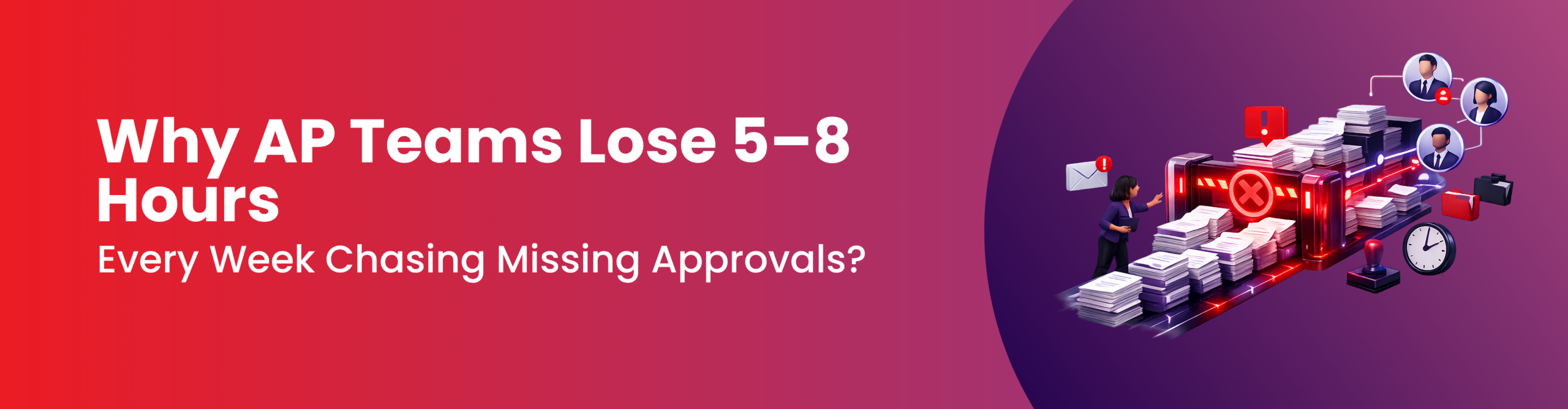

Why Accounts Payable Teams Lose 5–8 Hours Every Week Chasing Missing Approvals?
August 4, 2026
IMS Decimal Updates, Outsourced Accounting and Finance Services
Industry benchmarking consistently shows that Accounts Payable teams lose between five and eight hours every week simply chasing signoffs, and that figure rarely accounts for the downstream fallout of late payments, strained vendor relationships, or compliance gaps. The problem lies in the process which is built on friction rather than flow.
Every finance leader has felt it: an invoice sits untouched in a queue, waiting on a signature that never seems to arrive. A single missing approval rarely looks urgent in isolation. Multiplied across dozens of invoices a week, though, it becomes a structural drag on the entire finance function.
The Hidden Cost of a Broken Accounts Payable Process
An efficient accounts payable process should move an invoice from receipt to payment with minimal manual intervention. In practice, most organizations still rely on a patchwork of emails, spreadsheets, and verbal reminders to nudge approvers along.
That patchwork exacts a toll that rarely appears on a P&L statement but shows up everywhere else: delayed close cycles, duplicate payments, and AP staff who spend more time following up than actually processing.
Consider the cumulative arithmetic; if an AP analyst spends even ninety minutes a day tracking down approvers, sending reminder emails, or escalating stalled invoices, that adds up to roughly eight hours a week, an entire workday lost to administrative pursuit rather than strategic finance work.
Scale that across a team of five, and the organization is effectively paying for a full-time employee whose sole function is chasing paperwork. This is the quiet, compounding cost of an unstructured approval chain, and it disproportionately affects growing companies where invoice volume outpaces process maturity.
Where Accounts Payable Systems Break Down
Most breakdowns trace back to a handful of recurring culprits within accounts payable systems.
- Approval hierarchies are often undocumented or inconsistently enforced, so an invoice might sit in a manager’s inbox for days without anyone realizing it requires escalation.
- Multiple approval layers, particularly for high-value purchases, create bottlenecks whenever one person is traveling, on leave, or simply buried under other priorities.
- Disconnected tools compound the issue further, when invoice capture lives in one system, approval routing happens over email, and payment execution occurs in a separate ERP, nobody has a single, reliable view of where an invoice actually stands.
AP staff end up reconstructing status manually, cross-referencing spreadsheets against inboxes just to answer a simple question: has this been approved yet? That reconstruction work is where the hours quietly disappear.
The Real Price of Manual Invoice Processing
Manual invoice processing erodes performance through a thousand small inefficiencies. Data entry errors creep in when invoices are keyed manually across disparate platforms like:
- Approvers, overwhelmed by email volume, deprioritize finance requests in favor of more visible tasks.
- Vendors, tired of delayed payments, begin adding late fees or tightening credit terms, which in turn strains supplier relationships that took years to build.
When approval trails exist only in scattered email threads, reconstructing a clean audit history becomes a forensic exercise rather than a routine compliance check. Regulators and auditors expect a clear, time-stamped record of who approved what and when.
A fragmented accounts payable invoice processing workflow makes that expectation difficult to meet, exposing organizations to unnecessary risk during audit season.
How Accounts Payable Solutions Close the Approval Gap
Purpose-built accounts payable solutions address this gap by replacing ad hoc email chains with structured, rules-based workflows.
- Invoices are automatically routed to the correct approver based on predefined thresholds, department, or vendor category, eliminating the guesswork of who signs off on this?
- Escalation logic ensures that if an approver doesn’t respond within a set window, the request automatically reroutes to a designated backup, so nothing stalls indefinitely in a single inbox.

Most importantly, these systems create visibility whereby finance leaders can see, at a glance, exactly where every invoice sits in the pipeline, which approvals are pending, and which are overdue. That transparency alone often eliminates the need for manual chasing altogether, because bottlenecks surface proactively rather than being discovered after the fact.
Finance Process Automation as the Structural Fix
Approval routing is only one piece of a larger opportunity while true finance process automation extends across the entire invoice lifecycle, from initial capture and three-way matching to payment scheduling and reconciliation:
- Optical character recognition can extract invoice data automatically, reducing manual keying errors.
- Matching engines can validate invoices against purchase orders and receiving reports without human intervention, flagging only genuine exceptions for review.
This shift changes the nature of AP work entirely as instead of spending hours on repetitive administrative tasks, finance teams can redirect their attention toward vendor negotiations, cash flow forecasting, and strategic analysis.
Automation doesn’t eliminate the need for skilled finance professionals; it simply removes the friction that keeps them from doing higher-value work. For a deeper comparison of automation-led versus outsourced models, this analysis of outsourced accounts payable versus AP automation and which delivers better ROI breaks down the financial tradeoffs in detail.
Accounts Payable Outsourcing: A Faster Path to Control
For organizations that lack the internal bandwidth to overhaul their systems from scratch, accounts payable outsourcing offers a pragmatic alternative. Rather than building automation infrastructure in-house, companies can partner with specialists who already operate mature, structured workflows.
This approach compresses the timeline to results considerably, since the outsourced partner brings:
- Established approval protocols
- Escalation rules,
- Reporting dashboards
Outsourcing also introduces a layer of accountability that internal teams sometimes struggle to enforce among their own colleagues. When a third-party provider manages the approval workflow, service-level agreements create clear expectations around turnaround time, and those expectations tend to get honored precisely because they’re contractual rather than informal.
This model has proven particularly effective in sectors with complex compliance demands, as outlined in this examination of structured AP processes in US care homes, where regulatory scrutiny makes clean, auditable workflows non-negotiable.
Choosing the Right Accounts Payable Services Providers
Not all accounts payable services providers offer the same depth of capability, so due diligence matters. The strongest partners combine invoice processing services with genuine process consulting, helping organizations redesign their approval hierarchies rather than simply digitizing an already flawed workflow.
Providers like IMS Decimal, offer configurable escalation rules, real-time dashboards, and integration capabilities with existing ERP and accounting platforms.
Equally important is a provider’s ability to scale alongside invoice volume growth without introducing new bottlenecks. A provider that can demonstrate measurable reductions in approval cycle time, backed by client case studies and transparent reporting, is generally a safer long-term bet than one offering generic automation promises.
Organizations evaluating their options can review a full breakdown of comprehensive accounts payable and receivables management services to understand what a well-structured partnership actually looks like in practice.
Conclusion
The five to eight hours lost each week chasing missing approvals aren’t an unavoidable cost of doing business; they’re a symptom of process design that hasn’t kept pace with invoice volume or organizational complexity. Whether the fix comes through internal automation, a trusted outsourcing partnership, or some combination of both, the underlying goal remains the same: replace reactive chasing with proactive, structured visibility.
Finance teams that make this shift reclaim the strategic bandwidth that AP was always meant to support and the first step of this strategic shift can be done with an integrated partnership.
Frequently Asked Questions
- Why do accounts payable approval delays happen?
Approval delays occur when invoices move through manual workflows, email follow-ups, and unclear approval hierarchies, causing finance teams to spend valuable time tracking approvals instead of processing payments efficiently. - How do accounts payable solutions improve invoice processing?
Accounts payable solutions automate invoice routing, approval reminders, escalations, and status tracking, reducing processing delays, improving visibility, strengthening compliance, and enabling faster, more accurate vendor payments across organizations. - How does IMS Decimal support accounts payable operations?
IMS Decimal delivers structured accounts payable services, combining experienced finance professionals, standardized workflows, and process optimization to streamline invoice approvals, improve visibility, reduce bottlenecks, and strengthen operational control.