Summarize and analyze this article with:


How Accounts Receivable Services acts as a Cash Stability Lever for CFOs and Finance Teams?
February 25, 2026
IMS Decimal Updates, Outsourced Accounting and Finance Services
Cash trapped in receivables can become silent capital erosion. For CFOs and finance leaders, managed accounts receivable services are not an operational convenience but a cash-flow acceleration mechanism. By integrating invoicing, structured credit control, disciplined collections, and receivables analytics, these services compress DSO, stabilize working capital, and enhance liquidity visibility. Through combining these efforts, accounts receivable shifts from a passive balance sheet line item to an actively managed financial lever.
Why are Accounts Receivable Management Services a Strategic Leveller?
For experienced finance leaders, the question is no longer what is accounts receivable or is accounts receivable an asset. Accounts receivable is a current asset representing earned revenue pending collection. The strategic issue is how efficiently that asset converts into cash.
AR services have a direct influence on:
- Days Sales Outstanding (DSO)
- Cash conversion cycle
- Working capital ratios
- Borrowing base calculations
- Investor confidence in liquidity discipline
In capital-intensive US sectors such as healthcare, manufacturing, logistics, and enterprise SaaS, even a five-day DSO improvement can release substantial liquidity.
Well-structured AR services can transform accounts receivable from a reactive collections function into a forward-looking working capital engine. They bring predictability to cash flow, visibility to risk, and discipline to credit governance.
For CFOs under private equity oversight or lender scrutiny, that operational discipline becomes a valuation lever.
How Are AR Services Different from General Bookkeeping?
A common misconception is that AR is simply part of bookkeeping. While bookkeeping records transactions, services dedicated to AR actively manage revenue realization.
General Bookkeeping | Accounts Receivable Services |
Records invoices | Designs billing workflows |
Posts customer payments | Optimizes cash application accuracy |
Maintains ledgers | Manages credit risk exposure |
Produces financial reports | Drives DSO reduction strategy |
Reactive documentation | Proactive performance management |
While bookkeeping answers if the transaction recorded correctly, services pertaining to AR, give specificity to how quickly and predictably will this revenue convert into cash.
This distinction is critical for scaling US enterprises as customer contracts are becoming complex and multi-entity billing is on the rise. AR requires process engineering, automation, and performance analytics not just ledger accuracy.
Cash Flow Gaps That Poor Accounts Receivable Management Can Cause
Inefficient AR processes create silent liquidity pressure, and the impact often surfaces in secondary financial stress indicators.
Common Cash Flow Gaps
The following gaps often indicate structural weaknesses in accounts receivable management and can materially constrain liquidity, even in otherwise profitable organizations.
Rising DSO without root-cause clarity
When Days Sales Outstanding increases without a clear explanation, it signals process inefficiencies rather than isolated payment delays. The absence of root-cause analysis, whether related to billing errors, credit approval gaps, or dispute cycles, prevents targeted corrective action. Over time, this erodes liquidity predictability and weakens working capital control.
Frequent short-term borrowing to cover payroll or vendors
Regular reliance on short-term credit facilities to fund operational expenses often indicates delayed receivable collections. Even profitable businesses can face liquidity stress if cash conversion lags behind revenue recognition. This pattern increases financing costs, compresses margins, and exposes the organization to interest rate volatility.
Growing bad debt provisions
An increase in bad debt reserves reflects declining receivables quality and inadequate credit risk management. Without proactive credit assessments and ongoing monitoring, exposure accumulates silently. Elevated provisions not only impact profitability but also raise concerns among lenders and investors about asset reliability.
Disputed invoices lingering unresolved
Unresolved disputes typically point to weaknesses in billing accuracy, contract interpretation, or cross-functional coordination. When disputes remain open for extended periods, they inflate aging reports and delay cash realization. Structured dispute resolution workflows are essential to prevent revenue leakage and prolonged DSO cycles.
Weak visibility into customer credit exposure
Limited insight into customer payment behavior and credit concentration increases financial risk. Without segmented credit monitoring, companies may overextend exposure to high-risk customers. Strong visibility enables timely credit adjustments, reduces default probability, and strengthens overall accounts receivable asset quality.
Outsourced Accounts Receivable Services as a Solution That Restore Liquidity Discipline
Advanced providers integrate AR analytics directly into rolling cash flow forecasts as this improves treasury planning and reduces reliance on reactive funding.
High-performing outsourced accounts receivable services address the cash flow gaps systematically:
- Standardized invoice validation to reduce disputes
- Maker-checker cash application controls
- Structured escalation matrices
- Automated customer communication workflows
- KPI dashboards for CFO-level oversight
For a broader perspective on strengthening receivables processes, you may find our insights on outsourced receivable management for bridging the finance gap useful.
Structured accounts receivable outsourcing services provide:
A disciplined accounts receivable framework addresses structural weaknesses through clearly defined controls, analytics, and workflow standardization. Key components typically include,
- Credit policy enforcement
- Dispute resolution frameworks
- Aging trend analysis
- Automated reminder cadence
- Cash forecasting inputs
When these elements operate in coordination, receivables management shifts from reactive transaction processing to structured liquidity optimization.
How to Maximize Your Account Receivable Performance in 2026?
Forward-looking CFOs are redesigning AR for resilience and automation. By 2026, competitive advantage will depend on intelligent receivables infrastructure.
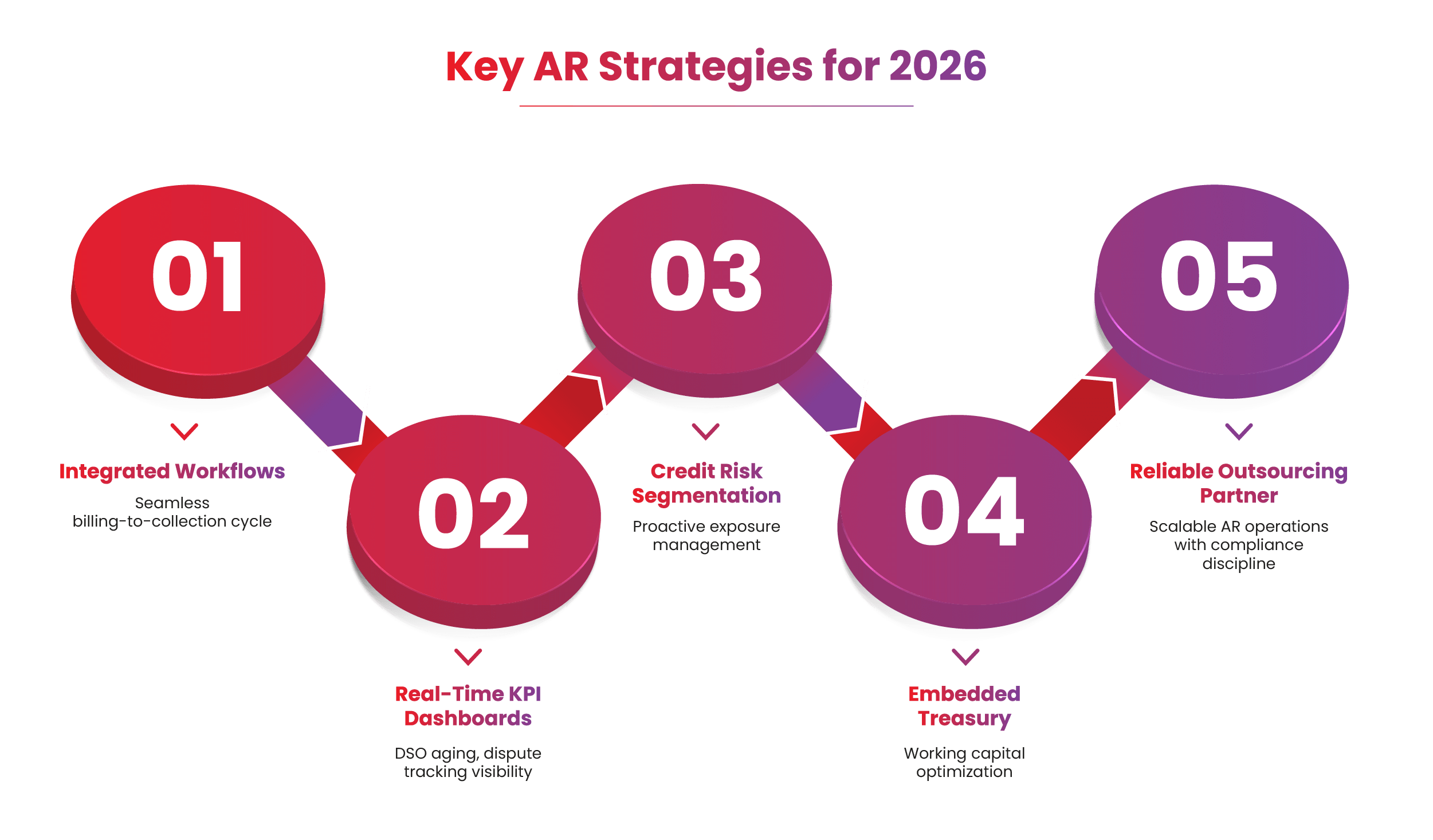
Key strategies include:
This shift requires a deliberate combination of technology, governance, and strategic partnerships.
Integrated Workflows
Automated billing triggers tied to contract milestones reduce manual error and improve invoice accuracy. Seamless workflow integration also strengthens cash application speed and reporting consistency.
Real-Time KPI Dashboards
Live DSO tracking, aging segmentation, and dispute categorization improve accountability. Executive dashboards provide CFOs with immediate visibility into receivables health and liquidity risk.
Credit Risk Segmentation
Dynamic credit limits based on payment behavior strengthen asset quality. Segmenting customers by risk profile reduces exposure concentration and supports proactive intervention.
Embedded Treasury Alignment
AR feeds directly into liquidity forecasting and covenant monitoring. Integrated treasury coordination enhances cash predictability and funding efficiency.
Reliable Outsourcing Partner
A reliable outsourcing partner brings structured processes, SLA-driven accountability, and scalable support. Beyond operational execution, the right partner strengthens internal controls, enhances reporting transparency, and enables finance leadership to focus on strategic oversight.
For companies evaluating broader outsourcing misconceptions, there are certain outsourcing accounting myths one must burst before selecting one.
Strategic Considerations Before You Decide
Before restructuring your AR function, evaluate:
- Is AR leadership focused on analytics or transaction processing?
- Are disputes tracked by root cause or handled individually?
- Is cash forecasting informed by live receivables data?
- Does your current structure scale with revenue growth?
If the answer is inconsistent, your AR framework may require redesign.
Conclusion: Accounts Receivable as a Working Capital Engine
For US CFOs navigating tighter credit markets, higher borrowing costs, and increased investor scrutiny, AR services play a central role in financial stability. When structured effectively, they enable liquidity acceleration, strengthen governance discipline, improve predictability in working capital performance, and enhance lender and investor confidence. These outcomes directly influence balance sheet resilience and valuation perception.
At IMS Decimal, our approach to accounts receivable outsourcing services combines process rigor, aligned workflows, and CFO-level reporting transparency. We support enterprises with structured credit control frameworks, dispute resolution governance, and performance dashboards that translate receivables data into strategic insight.
If you find your organization uncertain about the right strategic direction for receivables management, you are not alone. Many finance leaders recognize the need for stronger liquidity control but remain unsure how to redesign AR without disrupting operations.
To explore the right structure for your organization, evaluate your receivables maturity with a structured, data-driven approach.