Summarize and analyze this article with:
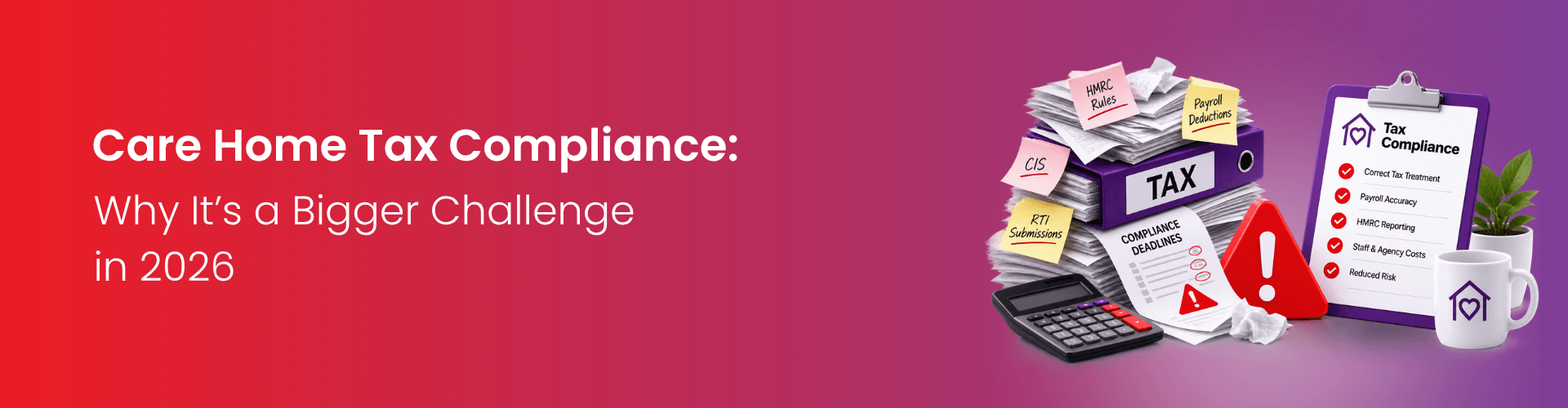
Why Tax Compliance Is Becoming a Bigger Finance Challenge for UK Care Homes
August 31, 2026
IMS Decimal Updates, Outsourced Accounting and Finance Services
Care home tax compliance is becoming a much bigger finance challenge for UK providers. Tax responsibilities have always required accuracy and attention, but today’s care home operators are managing those responsibilities alongside rising workforce costs, complex VAT considerations, payroll obligations, growing reporting requirements and increasing pressure on internal finance teams. As financial operations become more complex, tax compliance is no longer simply a year-end responsibility. It increasingly depends on the quality of financial records and processes maintained throughout the year.
For many care home groups, the challenge is not necessarily understanding that tax deadlines exist or knowing that records need to be maintained. The bigger challenge is ensuring that the information required for tax and compliance purposes is complete, accurate and available when it is needed.
This becomes more difficult as an organisation grows.
A single care home may have a relatively straightforward finance operation. However, a growing provider may be managing several locations, different payroll arrangements, hundreds of employees, multiple suppliers and a large volume of financial transactions. At that point, tax compliance becomes closely connected to the wider quality of the finance function.
If bookkeeping is delayed, reconciliations are incomplete or financial information is held across multiple systems and spreadsheets, tax preparation can become a reactive exercise. Instead of reviewing information throughout the year, the finance team may find itself trying to identify missing records and resolve discrepancies shortly before a deadline.
That is where risk begins to increase.
For UK care home operators, the question is therefore changing from “Are we meeting our tax obligations?” to “Do we have the financial processes and capacity needed to stay compliant as our organisation becomes more complex?”
Why Care Home Tax Compliance Is Becoming More Difficult to Manage
The UK care sector operates differently from many other industries. Care homes are not simply managing sales, purchases and payroll in a standard commercial environment. Their finance teams must work within a sector where staffing costs are high, services may involve different VAT treatments and operational activity continues around the clock.
At the same time, the financial pressure on providers remains significant.
Rising employment costs mean that payroll remains under constant scrutiny. Changes in staffing levels, sickness absence, overtime and agency cover can quickly affect monthly costs. Finance teams must maintain accurate records while also supporting management with information about financial performance.
Tax compliance sits within this wider environment.
HMRC requires employers to maintain payroll records showing payments, deductions and other relevant information accurately. These records can include what employees have been paid, deductions made, sickness and leave information, tax code notices and taxable expenses or benefits. HMRC may check those records, and employers generally need to keep them for three years from the end of the relevant tax year.
VAT also brings its own record-keeping requirements. VAT-registered businesses must keep records of purchases and sales, invoices received and issued, debit and credit notes, and other supporting information. HMRC also requires certain VAT records to be maintained digitally under Making Tax Digital rules, with VAT records generally kept for at least six years.
Individually, each responsibility may appear manageable. The challenge is managing all of them while running a busy care operation.
This is why tax compliance is increasingly becoming a finance management issue rather than a task that can be addressed only at the point of filing.
The Growing Risk of Fragmented Financial Records
One of the biggest challenges for care home groups is that financial information can become fragmented as the organisation grows.
Payroll information may sit in one system. Supplier invoices may be processed elsewhere. Bank reconciliations may be delayed. Supporting documents may be stored across different folders or managed by individual team members. Some financial information may still depend heavily on spreadsheets.
None of these issues automatically means that an organisation is non-compliant.
However, they can make tax compliance more difficult.
When information is fragmented, finance teams spend more time collecting data and less time reviewing it. A tax issue that could have been identified during a routine monthly review may only become visible when records are being prepared for a filing or compliance requirement.
The result is often unnecessary pressure.
For example, an invoice may have been processed but supporting documentation may not be easily accessible. A financial transaction may have been recorded incorrectly and only identified during a later review. Different locations may be following slightly different coding or record-keeping processes.
Over time, these small inconsistencies can create a larger administrative problem.
The issue is not always a lack of knowledge. Often, internal finance teams understand their responsibilities very well. The challenge is capacity.
As transaction volumes increase, maintaining consistently accurate records becomes more demanding. Finance teams may spend most of their time dealing with day-to-day processing, supplier queries, payroll administration and management requests. Proactive reviews can then become more difficult to prioritise.
That is one reason why better financial record-keeping should be viewed as an important part of care home tax compliance, rather than simply a bookkeeping exercise.
Tax Compliance Is No Longer Just About Meeting Deadlines
A reactive approach to tax can create the impression that compliance is mainly about submitting the correct information before a deadline.
In practice, a strong compliance process begins much earlier.
By the time a return or tax filing is being prepared, the underlying transactions have already taken place. The invoices have already been received. Payroll has already been processed. Financial records have already been created.
If errors exist at that stage, the finance team may need to spend significant time tracing transactions and correcting records.
A more proactive approach focuses on keeping financial information accurate throughout the year.
This means completing reconciliations regularly, maintaining supporting documentation and reviewing unusual transactions before they become part of a larger reporting problem.
The benefit is not only compliance.
Better records can also improve financial visibility. Finance leaders can have more confidence in management information when they know that underlying data is being maintained consistently.
For care home operators, this can be particularly important because financial decisions often need to be made quickly. A delayed or inaccurate financial picture can affect decisions around staffing, cash flow and operational investment.
Tax compliance therefore has a wider value than simply reducing the risk of an error.
It can encourage stronger financial discipline across the organisation.
VAT Creates a Particular Challenge for the Care Sector
VAT is one area where care home finance teams may need to manage more complexity than a standard business model would suggest.
The VAT treatment of care-related activities can depend on the nature of the services being provided and the circumstances of the provider. Care organisations may also have expenditure that requires careful consideration from a VAT perspective.
HMRC has also continued to provide specific guidance relating to VAT arrangements in the care industry. For example, HMRC’s Revenue and Customs Brief published in April 2025 addressed the use of VAT grouping involving state-regulated and non-state-regulated care providers. The guidance is specifically relevant to certain regulated care providers and demonstrates the importance of understanding how VAT rules apply to particular care-sector structures.
This does not mean that every care home faces the same VAT position. It means that general assumptions can be risky.
For finance leaders, accurate records become essential because VAT treatment depends on the underlying transactions and supporting information.
Poorly maintained documentation can make reviews more difficult. Inconsistent transaction coding can create additional work. If information needs to be reconstructed later, the process becomes slower and more resource-intensive.
This is why VAT should not be considered only when a return is due.
The quality of VAT reporting depends heavily on the quality of records created throughout the financial year.
Digital Record-Keeping Is Raising the Importance of Finance Processes
The direction of UK tax administration is also placing greater emphasis on digital records.
All VAT-registered businesses are generally required to follow Making Tax Digital for VAT rules unless they qualify for an exemption. This means maintaining relevant VAT records digitally and submitting VAT returns using compatible software.
Making Tax Digital for Income Tax has also begun to apply from April 2026 to certain self-employed individuals and landlords based on their qualifying income. While this does not apply in the same way to every care home organisation, it reflects the broader direction of travel towards digital record-keeping and more frequent digital tax processes.
For care providers, the bigger lesson is not simply about adopting software.
Technology can improve efficiency, but software alone does not guarantee accurate records.
A finance system can still contain incomplete information. A digital record can still be incorrectly coded. A process can still depend on someone manually entering information correctly.
The real value comes from combining technology with clear financial processes and regular review.
For a growing care home group, that may mean standardising how transactions are recorded across locations, creating clear approval processes and ensuring supporting documentation can be accessed when required.
Digital transformation should therefore support stronger financial discipline, rather than simply replacing paper with software.
The Pressure on Internal Finance Teams Is Increasing
Internal finance teams are expected to do much more than they were traditionally expected to do.
They process transactions. They manage payroll. They respond to supplier queries. They prepare management reports. They support budgeting and forecasting. They deal with auditors, advisers and regulatory requirements.
In a care home environment, those responsibilities can become particularly demanding because finance teams are supporting an operational business that never stops.
The challenge is that tax compliance often requires detailed and uninterrupted attention.
If a finance manager is dealing with payroll deadlines, urgent supplier issues and monthly reporting, a planned review of financial records may be delayed. If the team is already operating at capacity, compliance work may become concentrated around filing deadlines.
This does not necessarily indicate poor performance.
It can indicate that the organisation has outgrown the capacity of its existing finance structure.
This is an important distinction.
A care home group does not need to have a weak finance team to benefit from additional support. In many cases, experienced internal teams simply need more capacity to manage increasing transaction volumes and compliance responsibilities.
That is where outsourced tax and finance support can become a strategic option.
The Hidden Cost of Managing Tax Compliance Reactively
The cost of reactive tax management is not limited to potential penalties or compliance issues.
There is also an operational cost.
When finance teams need to investigate historical transactions, locate missing invoices or reconstruct financial records, valuable time is taken away from other responsibilities.
Senior finance staff may become involved in administrative tasks that could have been prevented through better processes earlier in the year.
There can also be an opportunity cost.
Time spent correcting historic information is time that cannot be spent on forecasting, cash flow management or improving financial performance.
For a care home CFO or Finance Director, this is an important consideration.
The question should not only be whether the organisation is able to complete its tax responsibilities.
It should also be:
How much effort is required to get there?
If every reporting period creates a significant administrative burden, the existing process may not be sustainable as the organisation grows.
A more efficient finance operation reduces the need for last-minute corrections and gives leadership teams more confidence in the information they are using.
When Should a Care Home Consider Outsourced Tax Support?
Outsourcing should not be viewed as an admission that an internal finance team cannot manage its responsibilities.
Often, it is a way to strengthen the existing team.
A growing care provider may consider outsourced tax support when financial complexity is increasing faster than internal capacity. This could happen when the organisation opens additional locations, experiences higher transaction volumes or finds that senior finance staff are spending too much time on routine compliance work.
The value of outsourcing comes from creating additional specialist capacity.
An outsourced partner can support the processes that sit behind tax compliance, including accurate bookkeeping, financial record maintenance and the preparation of information required for tax reporting.
For care home organisations, this can allow internal finance leaders to retain control while reducing the operational burden of routine back-office activity.
The right model is not necessarily about replacing the internal finance function.
It is about deciding which responsibilities should remain internal and where external support can improve capacity, consistency and efficiency.
How IMS Decimal Can Support Care Home Finance Teams
For IMS Decimal, this is where the connection should remain practical.
IMS Decimal provides outsourced accounting and financial back-office support across areas including bookkeeping, payroll and VAT support. For a care home finance team, these services can help strengthen the underlying processes that contribute to better financial compliance.
The value is not simply in completing a tax-related task.
It is in maintaining more consistent financial records throughout the year.
Accurate bookkeeping can provide a stronger foundation for reporting. Well-managed payroll records can support employment tax responsibilities. Better organisation of financial information can reduce the pressure involved in preparing for compliance requirements.
For a growing provider, outsourced support can also provide flexibility.
Rather than immediately expanding the internal team every time workload increases, care home operators can add external finance capacity where it is needed.
This can help internal finance leaders focus more of their time on financial strategy and performance while ensuring routine financial processes continue to receive appropriate attention
A More Sustainable Approach to Tax Compliance
The future of care home tax compliance is likely to depend less on last-minute preparation and more on the strength of everyday finance processes.
The most effective organisations will not wait until a deadline is approaching to discover whether their records are complete.
They will create processes that support accuracy throughout the year.
That means maintaining timely reconciliations, keeping supporting documents organised, reviewing financial information regularly and ensuring tax-related responsibilities are considered as part of normal finance operations.
For many care homes, this will also require a more connected relationship between finance, operations and external advisers.
Tax compliance cannot operate effectively in isolation.
It depends on information flowing accurately through the organisation.

Conclusion
Tax compliance is becoming a bigger finance challenge for UK care homes because the environment around it is becoming more complex.
Growing organisations are managing more transactions, more employees, more locations and greater financial pressure. At the same time, digital record-keeping and HMRC requirements are increasing the importance of maintaining accurate and accessible financial information.
The solution is not simply to become more focused at tax filing time.
It is to build stronger financial processes throughout the year.
Better records, regular reviews and consistent financial controls can reduce the pressure of reactive compliance and provide finance leaders with more confidence in their data.
For some care home groups, internal teams will continue to manage these responsibilities successfully. For others, growing complexity may create a need for additional specialist support.
That is where outsourced tax and financial back-office support can become valuable.
The right support model can provide additional capacity without removing control from the internal finance team. It can help create more consistent processes, improve the quality of financial information and reduce the administrative burden associated with maintaining compliance.
For UK care home leaders, the key question is no longer simply whether tax compliance is being completed.
It is whether the current finance operation is built to manage it effectively as the organisation continues to grow.
FAQs
1.Why is tax compliance becoming more challenging for UK care homes?
Tax compliance is becoming more challenging because care providers are managing growing financial complexity, including payroll responsibilities, VAT considerations, higher transaction volumes and increasing pressure on internal finance teams. The quality of day-to-day financial records has a direct impact on how efficiently compliance responsibilities can be managed.
2.How does poor financial record-keeping affect tax compliance?
Incomplete or inconsistent financial records can make it more difficult to prepare accurate tax information, locate supporting documentation and identify errors before filing. HMRC also has specific requirements for keeping VAT and payroll records. Strong record-keeping helps reduce the amount of time spent correcting historical information.
3.Can outsourced tax support help care home finance teams?
Yes. Outsourced tax support can provide additional capacity and specialist assistance while allowing the internal finance team to retain control of strategic financial decisions. It can be particularly useful for growing care home groups with increasing transaction volumes or limited internal finance resources.
4.Does Making Tax Digital affect care home providers?
VAT-registered care home businesses generally need to follow Making Tax Digital for VAT requirements unless exempt, including keeping relevant VAT records digitally and submitting VAT returns through compatible software. The wider expansion of digital tax processes also reinforces the importance of strong digital financial record-keeping.