Summarize and analyze this article with:
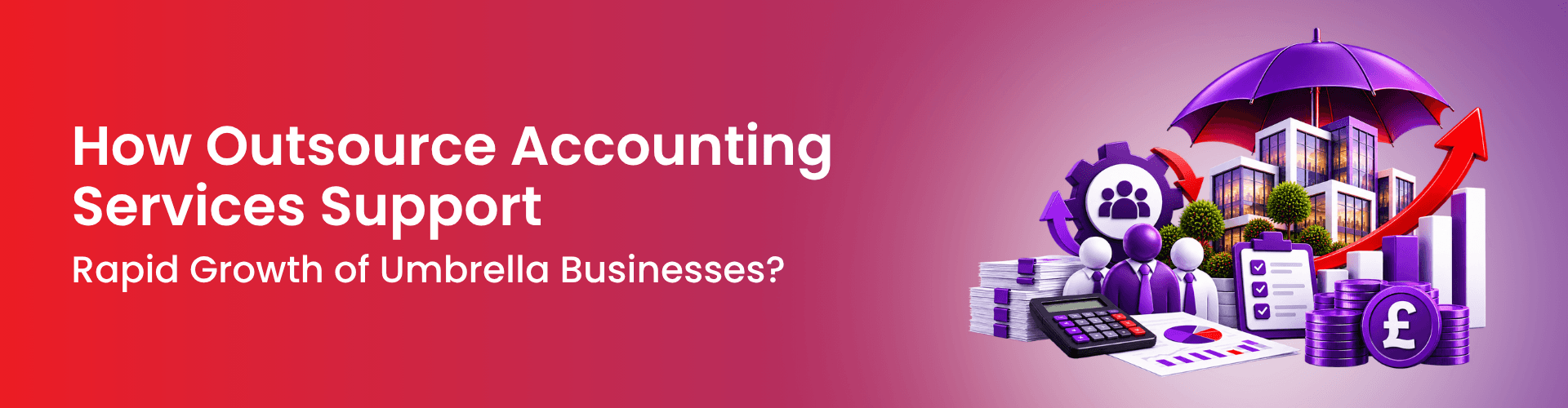
How Outsource Accounting Services Support Rapid Growth of Umbrella Businesses?
September 29, 2026
IMS Decimal Updates, Outsourced Accounting and Finance Services
Outsourcing accounting services helps umbrella businesses grow by adding finance capacity on demand, managing rising transaction volumes, improving accuracy, and giving leadership timely visibility into cash flow — without the cost and delay of expanding an in-house finance team.
Umbrella businesses operate on volume. More contractors, more clients and more invoices mean growth, but they also mean more payments to process, more records to reconcile and more deadlines to meet. As that volume increases, the accounting function behind it either scales to match it or becomes the constraint that slows growth down. This is where outsourced accounting services give umbrella businesses a scalable way to keep finance operations in step with growth.
Growth Is Good, But Can Your Finance Function Keep Up?
Not always. Business growth adds transactions, contractors and compliance obligations faster than most in-house finance teams can expand to match.
Every new contractor adds payment processing, expense records and reconciliation work. Every new client adds invoicing and follow-up. Hiring and training accountants takes time, and by the time a new hire is fully productive, volumes have often grown again. This gap between business growth and finance capacity is where many umbrella businesses start to struggle — not because growth is a problem, but because the back office wasn’t built to absorb it at the same pace.
Where Growing Umbrella Businesses Face Financial Pressure
Growing umbrella businesses typically feel financial pressure in seven areas:
- Contractor payments — accurate, on-time payments across a growing contractor base.
- Invoice volumes — raising, tracking and following up a rising number of invoices.
- Reconciliations — matching bank, client and contractor records consistently.
- Expense management — capturing, validating and recording contractor expenses correctly.
- Cash-flow monitoring — knowing what’s due in and out, and when.
- Reporting — producing timely, reliable management reports.
- Compliance — meeting filing and regulatory deadlines consistently.
Each of these is manageable at small scale. Together, at high volume, they can overwhelm a lean finance team.
What Happens When Accounting Processes Cannot Keep Pace?
Errors rise, reports arrive late, and leaders lose the financial visibility they need to make decisions.
- Processing delays — payments and invoices sit in queues.
- Increased errors — manual work under pressure leads to mistakes.
- Poor financial visibility — leaders can’t see the true cash position.
- Delayed reporting — month-end closes stretch out.
- Finance-team overload — staff spend time firefighting instead of improving processes.
- Difficulty supporting further growth — the business hesitates to take on new contractors or clients because the back office can’t absorb them.
6 Ways Outsourcing Accounting Services Can Support Growth
Outsourcing supports growth by adding capacity, handling volume, improving accuracy, strengthening cash-flow visibility, speeding up reporting, and relieving internal teams.
1. Increase Accounting Capacity
An outsourced provider brings a ready team of accounting professionals, with capacity that increases as contractor or client numbers rise — without a lengthy recruitment cycle.
2. Handle Higher Transaction Volumes
Defined workflows and dedicated resources let outsourced teams process high volumes of invoices, payments and entries consistently, including during peak periods.
3. Improve Financial Accuracy
Standardised procedures, review checks and regular reconciliation reduce the errors that creep in when in-house teams are stretched thin.
4. Strengthen Cash-Flow Visibility
Timely bookkeeping, receivables follow-up and payables tracking give leadership a clearer, more current view of cash coming in and going out.
5. Support Timely Financial Reporting
Regular month-end closes and structured management reports mean decisions are based on current numbers, not last quarter’s.
6. Reduce Pressure on Internal Teams
When routine transactional work moves to a specialist partner, internal finance staff can focus on budgeting, analysis and strategic support.

Outsourced vs In-House Accounting for Umbrella Businesses
Factor | In-House Accounting | Outsourced Accounting |
Cost structure | Fixed salaries, software, training | Flexible, often scaled to volume |
Scalability | Requires recruitment and training | Capacity added as needed |
Expertise | Limited to the team you hire | Access to a wider pool of accounting professionals |
Turnaround time | Can slow during peak periods | Process-driven, defined timelines |
Technology | Business buys and maintains its own tools | Provider brings established tools and workflows |
Risk | Key-person dependency | Documented processes and team backup |
Many umbrella businesses choose a hybrid approach — a small internal team for oversight and strategy, with transactional accounting handled by an outsourced partner.
How Can Outsourcing Support Contractor-Focused Accounting?
Outsourced teams can manage the high-volume, detail-heavy financial records that contractor-based models generate.
In an umbrella model, contractors, clients and payroll are closely linked, so accuracy in each record matters. Outsourced accounting support typically covers:
- Contractor-related financial data — organised, accurate, audit-ready records.
- Payroll coordination — aligning accounting records with payroll cycles.
- Expense records — capturing and validating contractor expenses.
- Client billing — timely, accurate invoicing.
- Reconciliations — matching bank, client and contractor records.
- Payment records — a clear trail for every payment made and received.
Why Scalability Matters in Umbrella Company Accounting
Because an umbrella business’s accounting workload grows with every contractor, client and service line added, support has to expand at the same pace.
- Contractor numbers — more people means more payments, records and queries.
- Client portfolio — more clients means more invoices and collections.
- Transaction volumes — growth in volume shouldn’t mean slower processing.
- Service lines — new services bring new reporting and compliance needs.
- Geographic coverage — expansion into new regions adds complexity.
A scalable accounting model lets the business say yes to growth without worrying whether the back office can cope.
Is Outsourcing Safe? Addressing Data Security and Control Concerns
Yes, when the right safeguards are in place — security and control should be assessed before choosing any provider. Umbrella businesses handle sensitive contractor and payment data, so caution here is reasonable. Look for:
- Confidentiality — signed NDAs and clear data-handling policies.
- Secure access — role-based access controls and secure systems.
- Visibility and control — regular reporting, review calls and defined SLAs.
- Clear communication — a dedicated team and a defined escalation process.
Outsourcing doesn’t mean giving up control. It means sharing execution while keeping oversight.
Signs It Is Time to Outsource Your Accounting
You may be ready to outsource if:
- Month-end close is regularly delayed
- Reconciliations are pending or error-prone
- Your finance team is constantly overloaded
- Contractor or invoice volumes are rising quickly
- You lack real-time visibility into cash flow
- Compliance deadlines feel increasingly tight
- Hiring for finance roles is slow or costly
If several of these apply, it’s worth exploring an outsourced model.
How to Choose the Right Outsourced Accounting Partner
A good partner should offer:
- Relevant experience — with umbrella, contractor-based or high-volume models.
- Core capability — accounts payable, accounts receivable, bookkeeping and reconciliations.
- Technology compatibility — the ability to work with your existing accounting software.
- Data security standards — clear policies and safeguards.
- Transparent pricing and SLAs — so expectations are clear from day one.
- Scalable teams — the ability to grow support as you grow.
How IMS Decimal Enables Umbrella Businesses To Build Scalable Accounting Operations
IMS Decimal provides outsourced accounting and finance back-office support designed to grow with the business. For umbrella businesses, this includes:
- Flexible outsourced accounting support that adapts to changing volumes.
- Experienced accounting professionals familiar with high-volume, contractor-based operations.
- Accounts payable and receivable management to keep payments and collections on track.
- Bookkeeping and reconciliation for accurate, up-to-date records.
- Financial reporting that supports timely decision-making.
- Process-driven delivery with defined workflows and review stages.
- A scalable support model that expands as contractors, clients and transactions increase.
From Accounting Administration to a Scalable Finance Function
Outsourcing is often framed as a cost-saving move, but for growing umbrella businesses its bigger value is operational. It converts accounting from a routine administrative task into a scalable function that supports expansion, improves visibility, and frees leadership to focus on strategy rather than processing.
Conclusion: Make Accounting Ready for the Next Stage of Growth
Rapid growth is a good problem to have, but only if the finance function can keep up with it. Outsourcing accounting services gives umbrella businesses three things growth depends on: capacity that scales with contractor and client volume, accuracy that holds up under pressure, and timely visibility into cash flow and performance.
With the right partner in place, accounting stops being a constraint on growth and becomes part of what makes the next stage of it possible.
Frequently Asked Questions
What is outsourced accounting for umbrella businesses?
It’s the practice of engaging a specialist provider to handle accounting tasks such as bookkeeping, accounts payable and receivable, reconciliation and reporting for a business managing contractors and high transaction volumes.
When should an umbrella business outsource accounting?
When growth in contractors, clients or invoices starts causing delays, errors, late reporting or overload in the finance team, it’s usually time to consider outsourcing.
Can outsourced accounting handle high transaction volumes?
Yes. Outsourced providers use defined workflows, dedicated teams and review processes built to manage large volumes consistently.
Is my financial and contractor data safe with an outsourced provider?
It can be, provided the provider has strong safeguards such as NDAs, access controls and secure systems in place — these are worth reviewing before signing.
How does outsourcing help with cash-flow visibility?
Timely bookkeeping, receivables follow-up and regular reporting give leaders a current view of what’s due in and out, so cash decisions are based on real numbers.